Showing posts with label Bush Theatre. Show all posts

Tuesday, 28 July 2015

#5. The Pitchfork Disney

Nathan Stewart-Jarrett as Cosmo
Disney in the 2012 revival.
The Pitchfork Disney by Philip Ridley
Premiere: Bush Theatre, London (2 January 1991)
Published by Methuen Drama

Philip Ridley's debut play, The Pitchfork Disney, was a controversial hit when it premiered at the Bush Theatre in 1991, and Edward Dick's 2012 revival at the Arcola was heralded as a prophecy that had come of age. Aleks Sierz credits it with sparking the new wave of in-yer-face writing during the 1990s from writers like Sarah Kane and Mark Ravenhill. Is all this praise really due?

It is without a doubt a bold debut, announcing the arrival of an audacious new writing talent. Ridley sets it in a dimly lit room in the East End of London, inhabited by infantilised twins Presley and Haley Stray who fantasise they are the only survivors of a nuclear holocaust. Their agoraphobia is extreme; the only time either of them leaves the flat is to restock on chocolate or the medicine their parents used to take.
"You know why the ghost train is so popular? Because there are no ghosts. Once you know that you can make a fortune." Cosmo
They live stably in the stagnancy of exchanging stories about the past, their dreams, and horror stories of the outside world to keep reality at bay. That is, until Presley spots a beautiful young man on the street outside who is apparently sick, and invites him in. It is Cosmo Disney, a sequinned perfection who makes a living eating insects alive onstage. Cosmo, along with his sinister associate Pitchfork Cavalier, aggressively invades the safety of the twins world. Worse still, Cosmo is drawn to Haley's vulnerability and knows exactly how to exploit Presley's attraction to him.

The power play between the characters is fascinating. Ridley sets up a very dynamic relationship of mutual reliance between Presley and Haley in the first section, before disrupting it in Presley's desire to please Cosmo. Cosmo brings with him a different bag of tricks for surviving the world, which he demonstrates for Presley. His ethos in life is this: "You know why the ghost train is so popular? Because there are no ghosts. Once you know that you can make a fortune."
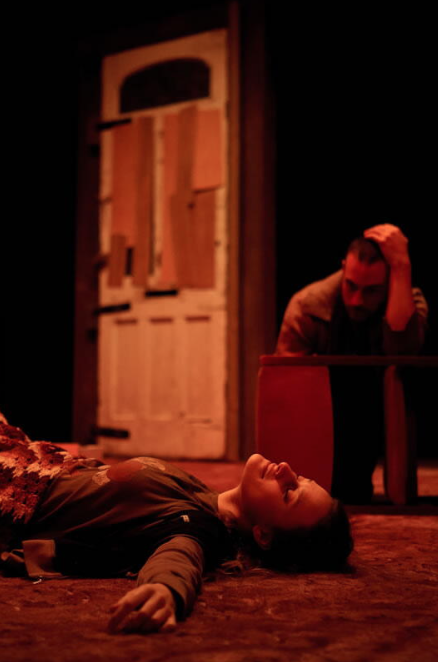
Mariah Gale (Haley) & Chris New
(Presley) in the 2012 revival.
What is truly impressive is Ridley's ability to marry harrowing psychological realism with poetic fantasy. Presley and Haley have regressed to childishness, living in the house of their dead parents. His depiction of their curious mental state and their desperation to rediscover the comfort and safety of childish innocence, is shrewdly accurate. The centrepiece of the play is Presley's mammoth monologue where he invents the beautiful but cruel child murderer, the Pitchfork Disney himself, in a story which climaxes in the destruction of the world in nuclear fallout, before ending with invincible solitude as the only survivor.

Ridley's writing is intensely poetic. Writing of this potency is rare even in from the more experienced playwrights, yet Ridley shows his unequaled ability to conjure even the most disturbing images. From the sizzle of burning snakes, to the crunch of cockroaches being eaten alive, to the howls of rabid dogs, his imagery is unique, expressive and affecting. There is something primal and visceral in the imagery Ridley uses that doesn't weaken with age - it grabs something deep in your soul and refuses to loosen its grip.

The play itself, in all its surrealist strangeness and storytelling fervour, is like a nightmare itself. It seems to exist in the nowhere world of dreams, where the recognisable is suddenly alien and the cruelness of life is uncensored. Ridley finds a palette of aggressive imagery and characters caught in dream-state. The gothic vision of East London with its echoes of Cold War paranoia, desperate violence and sexual hysteria is rooted in a wider commentary on a society of anxiety and fear. Nothing is gratuitous - it is meticulously economic storytelling. Ridley's prophecy, over two decades on, still feels timely.

What is truly interesting about this play, and indeed all three in the unofficial 'East End Gothic Trilogy' - The Pitchfork DisneyThe Fastest Clock in the Universe and Ghost From a Perfect Place - is that for all the imagery of post-apocolyptic worlds and abandonment, the plays are still very much set in the real world. This is interesting when compared to later plays like Mercury Fur which are in fact really set in some sort of dystopian apocalyptic future. The Pitchfork Disney experiments with these ideas, but there is something even more haunting in the fact that they are fantasies in the minds of his characters.

The Pitchfork Disney is a modern masterpiece; it is, in fact, little wonder that it is credited with rewriting the rules of British theatre.

Nathan Stewart-Jarrett (Cosmo) and Mariah Gale (Haley) in the 2012 London revival.
Buy on Amazon.
Philip Ridley's new play, Tonight With Donny Stixx, will play at the Pleasance at the Edinburgh Fringe this summer. Find out more here.

Friday, 24 July 2015

#3. Beautiful Thing

20th Anniversary revival cast 2013
Beautiful Thing by Jonathan Harvey
Premiere: Bush Theatre, London (28 July 1993)
Published by Methuen Modern Plays

Jonathan Harvey’s play Beautiful Thing is one I keep coming back to. I first read it at secondary school (a surprisingly long time ago now!) and I adored Nikolai Foster’s tremendous 20th Anniversary revival at the Arts Theatre a few years ago. I recently found a dog-eared, heavily annotated copy of the script on my shelf – with all the swear words replaced, presumably to make it acceptable to the archaic, omnipotent secondary school sensors – and thought I’d give it another read.

Beautiful Thing is without a doubt a seminal play about young gay love, and it is no wonder that it is still so popular with audiences. Harvey really captures a true sense of the early 1990s, now appropriated as ‘retro’ by uber-cool Hackney hipsters. Harvey’s characters are delightfully, sensitively drawn and their relationships are not sensationalised resulting in a play that feels like it could be totally real but especially in the nineties must have seemed inconceivable.

Sam Jackson, Thomas Law & Charlie
Brooks in the UK tour 2015
(photo by Anton Belmonte)
Jamie and Ste are the central duo, a long-standing friendship that blossoms into something more as the two discover their sexuality in a concrete-grey world. Their friendship is layered; gratifyingly, they do not always see eye to eye, they have different interests and different allegiances and yet their friendship is strong enough to come through. More importantly, they are not defined by their sexuality. So often gay characters are little more than a flat representation of a writer’s idea of gayness. But Harvey gives them both a real depth that makes their story all the more interesting, and their mutual attraction all the more plausible. Why, even now, is this kind of writing for gay characters so rare?

What Harvey manages to achieve in this play is an avoidance of what have become archetypal plot lines. We don’t get the stereotypical coming out scenes, we don’t have overpowering camp blinding us, and we don’t have a mythical, stuff-of-wet-dreams, perfect gay couple either! We have unapologetically real people. I know this may seem obvious, but really it does seem so rare to see a gay character that isn’t there for comic relief or some hackneyed coming out storyline that this now almost 25-year-old play is still a refreshing read. I think this achievement is what makes the play resonate with so many young people, gay or not; it is stuff young people recognise and can relate to!
There is a great deal of hope residing in the cracks of these characters’ lives, hope for us all.
The unconditional mother-son relationship is shrewdly observed. Neither of them is perfect – Sandra messes up just as much as any mother trying desperately to do her best might, and Jamie isn’t always the perfect son (is anyone?). But Harvey paints an exquisitely delicate picture of a relationship that manages to find a way, muddling through together.

Harvey’s ear for the dialogue of rough-edged teens and their elders caught in a habit of defensiveness and wariness is second to none – it jumps right off the page. He captures the rhythms of the overlapping conversations of those who spend almost too much time together impeccably.

Harvey’s choice to set the play in the semi-domestic realm of the landing walkway outside the flats is smart. It is a much more interesting and versatile space than, say, a living room or something similar. The space gives glimpses of the lives behind the front doors of the three young characters, but these moments are earned not given away. It allows the characters to feel at once comfortable in their shared ownership of the space and yet still not quite in the private environs of an interior so there is a nice tension present. Practically, it also grants a nice open playing space that can quickly be transformed into Jamie’s bedroom.

Gerard McCarthy, Charlie Brooks & Vanessa Babirye
in the UK tour 2015 (photo by Anton Belmonte)
The original play is subtitled, wittily, ‘An Urban Fairytale’ (in the latest production this was interesting changed to 'A Love Story'). I bring this up because of the nice play on the slang word ‘fairy’; it sums up Harvey’s tongue in cheek, joyous approach to telling this story. The characters are not without their troubles, but Beautiful Thing seems to rejoice in the beauty of the mundane, the beauty of two ordinary boys being able to discover love for the first time. Pointing it out as a fairytale does remind us that Harvey perceives a story of boys being able to find love and acceptance as something of an idyllic dream, and in 1993 that was even more exaggerated than it is now with all the apparent headway made in the gay rights movement. That said, it is encouraging that Harvey’s story feels less of a fantasy today - though I wonder in performance how we rediscover the shock original audiences must have felt at this fantasy to avoid it feeling nostalgic and out of date.

The final scene, underscored by Mama Cass’ Dream a Little Dream of Me – which you can hear ringing out even just reading the script – is stunningly rousing. There is a great deal of hope residing in the cracks of these characters’ lives, hope for us all that one day this story won’t be a fairytale anymore but a lived reality for young people universally.

Jack Davies and Danny Boy Hatchard in the 20th Anniversary revival at the Arts Theatre
(photo by Alastair Muir)

Watch the 20th Anniversary production on Digital Theatre here.
Buy on Amazon here.