Showing posts with label Jack Thorne. Show all posts

Tuesday, 8 September 2015

#15. Hope

Hope by Jack Thorne
Premiere: Royal Court Jerwood Theatre Downstairs (26 November 2014)
Published by NHB Modern Plays

Jack Thorne's optimistically titled political play Hope was recommended by a friend of mine, and it is a wonderful read. It centres around a small local Labour council and its struggling councillors fighting to survive through the crushing cuts the Conservative government have been forcing through in recent years. It is a cutting satire, which audiences of all political persuasions will be able to get a handle on. 

It has all the hallmarks of Jack Thorne's style. It is episodic, concise and economic while still having a wide-reaching resonance, and the central fight is essentially unwinnable. The council presented becomes a symbol of a country's larger struggle in the face of troubled economic times. Thorne's dialogue is quirky and tight, with a great sense of irony piercing the air throughout.
Jack Thorne's play will become seen as a wider indictment of the British two-party political system, and the ways in which several successive governments on both sides of the fence have failed.
What Thorne does so well in this play is what good journalists manage to do with huge, unwieldy subjects; he makes it personal. By focussing on a small group of counsellors and branching out to consider their personal lives alongside the professional, Thorne's play becomes touching, compassionate and human, as well as intensely political. 

It seems fair to say that Thorne has a slight leaning towards the left side of the argument, but his play not only examines the perceived damage of Tory budget cuts which disproportionally affect working class towns, it also examines the failings of the contemporary Labour Party and of the Labour/socialist movement as a whole. His taut character list spans several generations using the counsellors as the epicentre; an elderly father - a counsellor himself through the seventies - is the epitome of the post-war Labour movement, a teenage child represents the varying apathy and idealism of youth.  

In some respects, the play is already historical, as is the danger with writing an immensely timely play. It is very specifically located a few months before the last election, with comments made about "Ed's" concerns. And part of the play's power is its grounding in a set of all-too real circumstances, which for audiences at the time would have felt even more poignant. That said, I would suggest that going forward the play will find a different resonance; it will become seen as a wider indictment of the British two-party political system, and the ways in which several successive governments on both sides of the fence have failed. It shrewdly portrays the limits of our elected representatives, and their own selfish battles to achieve re-election and promotion.

Jack Thorne's writing finds power and resonance in the extraordinary moments within the everyday lives of those pushed forward to lead. Marvellously, it is not a dreary play - as the title suggests, there is optimism, humour and hope all loitering around in the age of austerity. Thorne doesn't preach or thrust forth his own solutions. Rather, his quietly profound play leaves you reconsidering many of your own political views, and questioning the political system as a whole. Truly effective, urgent satirical writing.

All photos of John Tiffany's production at the Royal Court, designed by Tom Scutt.
Photos by Johan Persson
Also by Jack Thorne: #10. Mydidae
Buy on Amazon here.

Saturday, 8 August 2015

#10. Mydidae

Kier Charles & Phoebe Waller-Bridge
Mydidae by Jack Thorne
Premiere: Soho Theatre, Upstairs (5 December 2012)
Published by NHB Plays

The Mydidae is a short-living, stinging fly and in his play of the same name, Jack Thorne compels the audience to be flies on the wall of a deeply intimate series of vignettes.

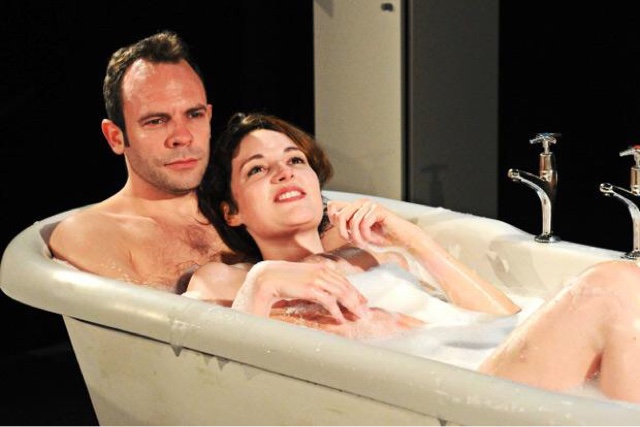
Mydidae is set entirely in married couple Marian and David’s bathroom and takes place over the course of a single day, from the light-hearted banter of morning ablutions to a disastrously failed attempt at a romantic candle-lit bath in the evening. Their relationship initially seems effortlessly comfortable; there are no qualms about peeing or flossing or shaving in front of one another. Gradually, though, Thorne’s script reveals that this day is the painful anniversary of a shattering event that has left its mark on both characters and an indelible scar on their relationship. They are held together as much by despair and remorse as by the love they once shared.
"I wanted you to stop being there. Yeah. I wanted you to stop." David
Kier Charles & Phoebe Waller-Bridge
Jack Thorne’s script has a dark sense of humour throughout, as the characters take progressively more unforgiving jabs at each other. These range from a knowing, snide remark from Marian about David's "small horse", to more cutting comments about past loves and heartbreak. Thorne has managed to find with precision the unique way in which two people who know each other better than anyone else have an unchallenged ability to hurt the deepest. 

Location is used skilfully; bathrooms are where we are at our most exposed, our most rudimentary, our most bare. Marian, particularly, finds safety in the solitude of the bathroom in some moments. The characters have, by the climax, both physically and emotionally stripped each other completely naked. There is something striking in this simplicity. 

What is very enjoyable about this script is that the characters jump right off the page. Thorne has created a delightfully gawky couple, swimming in insecurities. But they are not mismatched; their idiosyncrasies make them perfect for each other. They are in fact deeply reliant on each other, for all their inadequacies, and one gets the feeling that they perhaps wouldn't survive alone.


Phoebe Waller-Bridge
Structurally, the play is a series of short vignettes, economically giving snapshots of the bathroom through the day. The longest scene, begun at the start of the play with the real-time running of the bath continuing throughout the bursts of action, is the main set piece of the play. David sets out candles and works very hard to create an atmosphere of romance, which goes largely unappreciated by a distracted Marian. They do, though, bathe together, swapping stories of their lives through the fog of their equally bad memories. We discover, through this scene, that David is working so hard as it is the anniversary of the death of their only child. Both parties are clearly still grieving though dealing with their loss in different ways. It is gut-wrenching as David's desperation confronts Marian's hopelessness. The bath reaches a rather violent climax; Thorne actualises many couple's secret wish. In the words of David; "I wanted you to stop being there. Yeah. I wanted you to stop." Their grief turns them in on each other, as if imploding in slow motion. Quite rightly, though shatteringly, there is a sense of gratitude for this violence; Marian seems to feel a release in being hurt. Perhaps she feels she deserves it, perhaps as she says it is just because for those moments "it stopped the clock in my brain". There is a real pained honesty ringing through in these moments.

There is a risk in the structure of the play that it becomes so episodic and brief that you cannot truly get to grips with the characters, or get inside their heads. The only time you see them interact with anyone else is through hearing one side of phone calls, which is a shrewd way of bringing in other relationships but still has limitations in scope. Marian's relationship with her mother, for instance, is only briefly glimpsed and it is a shame that more is not made of this. Perhaps there are ways of expanding the reach of the moments when each character is on their own in performance that would be beneficial.

Thorne also has the expert ability of creating sharp-edged dialogue that zips along with pace and vivacity. It is an incredibly quick read, as Pinter plays often are, but that is not because it is empty; the power in the script is, often, in the things that are left unsaid. Mydidae is a thoughtful examination of hope despite hopelessness, of relationships under unimaginable strain. It is shocking and surprising in equal measure, and even as a reader one can feel an absorbing sense of uncomfortable voyeurism leaking from the script. 

Kier Charles & Phoebe Waller-Bridge in the original Soho Theatre production