Showing posts with label Soho Theatre. Show all posts

Saturday, 8 August 2015

#10. Mydidae

Kier Charles & Phoebe Waller-Bridge
Mydidae by Jack Thorne
Premiere: Soho Theatre, Upstairs (5 December 2012)
Published by NHB Plays

The Mydidae is a short-living, stinging fly and in his play of the same name, Jack Thorne compels the audience to be flies on the wall of a deeply intimate series of vignettes.

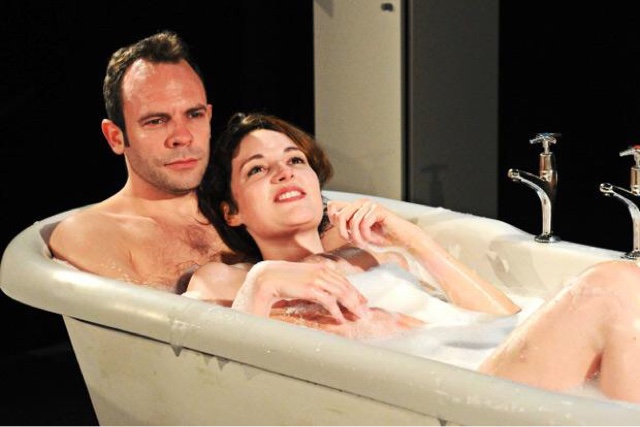
Mydidae is set entirely in married couple Marian and David’s bathroom and takes place over the course of a single day, from the light-hearted banter of morning ablutions to a disastrously failed attempt at a romantic candle-lit bath in the evening. Their relationship initially seems effortlessly comfortable; there are no qualms about peeing or flossing or shaving in front of one another. Gradually, though, Thorne’s script reveals that this day is the painful anniversary of a shattering event that has left its mark on both characters and an indelible scar on their relationship. They are held together as much by despair and remorse as by the love they once shared.
"I wanted you to stop being there. Yeah. I wanted you to stop." David
Kier Charles & Phoebe Waller-Bridge
Jack Thorne’s script has a dark sense of humour throughout, as the characters take progressively more unforgiving jabs at each other. These range from a knowing, snide remark from Marian about David's "small horse", to more cutting comments about past loves and heartbreak. Thorne has managed to find with precision the unique way in which two people who know each other better than anyone else have an unchallenged ability to hurt the deepest. 

Location is used skilfully; bathrooms are where we are at our most exposed, our most rudimentary, our most bare. Marian, particularly, finds safety in the solitude of the bathroom in some moments. The characters have, by the climax, both physically and emotionally stripped each other completely naked. There is something striking in this simplicity. 

What is very enjoyable about this script is that the characters jump right off the page. Thorne has created a delightfully gawky couple, swimming in insecurities. But they are not mismatched; their idiosyncrasies make them perfect for each other. They are in fact deeply reliant on each other, for all their inadequacies, and one gets the feeling that they perhaps wouldn't survive alone.


Phoebe Waller-Bridge
Structurally, the play is a series of short vignettes, economically giving snapshots of the bathroom through the day. The longest scene, begun at the start of the play with the real-time running of the bath continuing throughout the bursts of action, is the main set piece of the play. David sets out candles and works very hard to create an atmosphere of romance, which goes largely unappreciated by a distracted Marian. They do, though, bathe together, swapping stories of their lives through the fog of their equally bad memories. We discover, through this scene, that David is working so hard as it is the anniversary of the death of their only child. Both parties are clearly still grieving though dealing with their loss in different ways. It is gut-wrenching as David's desperation confronts Marian's hopelessness. The bath reaches a rather violent climax; Thorne actualises many couple's secret wish. In the words of David; "I wanted you to stop being there. Yeah. I wanted you to stop." Their grief turns them in on each other, as if imploding in slow motion. Quite rightly, though shatteringly, there is a sense of gratitude for this violence; Marian seems to feel a release in being hurt. Perhaps she feels she deserves it, perhaps as she says it is just because for those moments "it stopped the clock in my brain". There is a real pained honesty ringing through in these moments.

There is a risk in the structure of the play that it becomes so episodic and brief that you cannot truly get to grips with the characters, or get inside their heads. The only time you see them interact with anyone else is through hearing one side of phone calls, which is a shrewd way of bringing in other relationships but still has limitations in scope. Marian's relationship with her mother, for instance, is only briefly glimpsed and it is a shame that more is not made of this. Perhaps there are ways of expanding the reach of the moments when each character is on their own in performance that would be beneficial.

Thorne also has the expert ability of creating sharp-edged dialogue that zips along with pace and vivacity. It is an incredibly quick read, as Pinter plays often are, but that is not because it is empty; the power in the script is, often, in the things that are left unsaid. Mydidae is a thoughtful examination of hope despite hopelessness, of relationships under unimaginable strain. It is shocking and surprising in equal measure, and even as a reader one can feel an absorbing sense of uncomfortable voyeurism leaking from the script. 

Kier Charles & Phoebe Waller-Bridge in the original Soho Theatre production

Wednesday, 22 July 2015

#1. Blink

Original cast: Harry McEntire and Rosie Wyatt
Blink by Phil Porter
Premiered at the Traverse Theatre, Edinburgh (2 August 2012)
Published by Oberon Modern Plays

So here goes, play number one is Phil Porter’s Blink, a punchy two-hander. Blink tells the story of outsiders Jonah and Sophie. Jonah moves from his sheltered Presbyterian home to a flat Leytonstone, East London. Sophie had lived with her father, until his recent death. With the unbidden delivery of a video baby monitor, connected to a camera in Sophie’s flat, Jonah begins to observe her while she pretends to be unaware. Eventually the safety found in the distance of this voyeurism is disturbed when Jonah figures out that she is in the flat upstairs, and their connection spills out into the real world.
"Love is not a cast iron set of symptoms. Love is whatever you feel it to be. Love is neither dirty nor clean." Jonah
The first line comes from Jonah; “This is a true story, and it’s a love story.” This playfully opens what is a wonderfully theatrical play, turning the characters’ audience address into two people confiding in the audience their own experience of a relationship. As a form of memory play, Porter relishes the opportunities for dissonance in the recollection of events between Jonah and Sophie, and finds real humour and silliness in their story. Porter has mastered audience address in this piece, creating a real depth and need in his characters.

For the first part of the play Jonah and Sophie seem to be in separate worlds, not engaging with the other. Then suddenly, the worlds cross over, with both Jonah and Sophie filling in for characters in the other’s story but without necessarily fully becoming them. There is a rather fun stage direction on the first instance of this; “If there’s a brief moment of confusion at the point of transition, all the better.” There are clear indications throughout the script that the piece acknowledges its own theatricality, which opens up lots of opportunities for play in performance. It also bridges the gap in the storytelling, allowing key scenes to become immediate rather than recounted.

Eventually, of course, the two characters interact themselves, as their stories gradually align. This process is beautifully drawn by Porter; he finds all the opportunities for mundane absurdity and surprise in the inevitability of their meeting. It is then even sweeter when the two finally have a conversation, decoding the layers of fantasy the audience have been complicit in them building around themselves.

Porter delivers one final surprise, just as it seems the play may veer off into sentimentality. There is no fairy tale ending; no neat bow. There is a feeling in this that the audience is being given the story up until now, but it will go on and who knows what might happen next week, or next year. It lives up to Jonah’s description of love in his opening speech; “Love is not a cast iron set of symptoms. Love is whatever you feel it to be. Love is neither dirty nor clean.”

With that description in mind, it then becomes apparent that while telling the central, albeit unconventional ‘love story’, Porter examines other forms of love in Jonah and Sophie’s lives. Be it their relationship with their parents, estate agents, doctors, random strangers that they collide with in the street, or the mangy fox that lives in the garden.

In this emerges the idea of love growing out of a need. Jonah and Sophie certainly need each other, and indeed have a certain need for the other characters that cameo in their lives – yes, even the mangy fox! But that said, in Porter’s play that doesn’t diminish the validity of the love. The final resolution suggests a very natural ebb and flow of relationships, and through even the most fleeting of these relationships we may come to find a better understanding of who we are.

Photo by Sheila Burnett